

NEWYou can now listen to Fox News articles!
Older travelers who may be limited in their dexterity should be spread out across a flight’s seating — not just for their own safety, but for the safety of everyone on board, scientists say.
The Federal Aviation Administration (FAA) requires aircraft to be able to evacuate within 90 seconds in case of an emergency — but as the average age of the population across the globe increases, experts say the growing number of elderly airline passengers poses new challenges in emergency situations.
An international team of researchers simulated 27 different evacuation scenarios in the case of a dual-engine fire on an Airbus A320, one of the most common narrow-body aircraft in the world, news agency SWNS reported.
PLANE SEAT LOCATION CRITICAL IN EMERGENCIES AS EXPERTS WARN ROW POSITION IMPACTS SURVIVAL ODDS
The team compared three different cabin layouts with three different ratios of passengers over age 60 — and three different distributions of those passengers for the study.
Study co-author Chenyang Zhang, Ph.D., of the University of Calgary in Canada, said of the research, “While a dual-engine fire scenario is statistically rare, it falls under the broader category of dual-engine failures and critical emergencies in aviation. History has shown,” he added, “that dual-engine failures and emergencies, such as the famous ‘Miracle on the Hudson’ involving Captain [Chesley] Sullenberger, can happen and lead to severe consequences.”

A study team compared three different cabin layouts with three different ratios of passengers over age 60 — and three different distributions of those passengers for the study. (iStock)
He added, “Our study focuses on these low-probability but high-impact events to ensure the highest safety standards.”
To seek the most efficient combination of factors, the research team created full-scale computer-aided design models of the A320 cabin and used Pathfinder — the industry-standard software for evacuation modeling — to simulate passengers’ behavior.
Reduced dexterity can be exacerbated during high-stress situations.
The findings were published in AIP Advances, a peer-reviewed journal of the American Institute of Physics. The results showed that the proportion and location of elderly passengers had the largest effect on evacuation time.
The fastest option — a layout that accommodates a total of 152 passengers with two rows of first-class seats at the front, and 30 elderly passengers evenly distributed throughout the cabin — still required 141 seconds for all passengers to reach the ground.
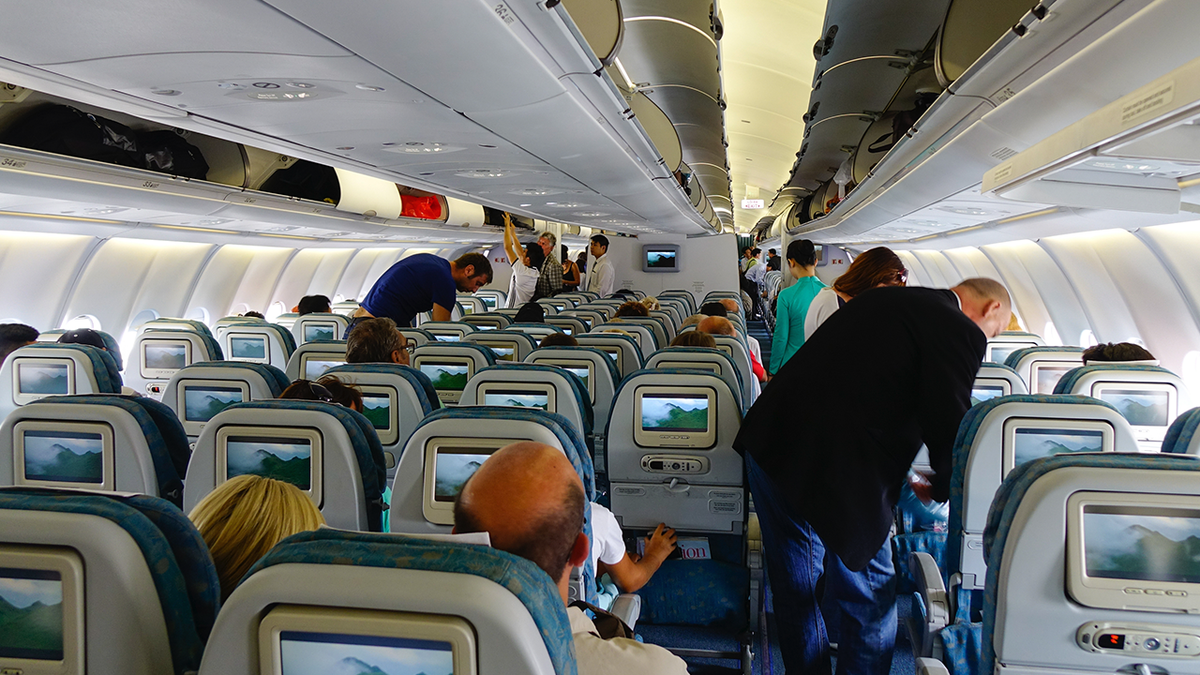
The new findings were published in the journal AIP Advances. The study results showed that the proportion and location of elderly passengers on board a flight had the largest effect on evacuation time. (iStock)
That’s much longer than current FAA mandates.
Previous studies have shown that cognitive decline in elderly people can affect situational awareness and delay decision-making, and that reduced dexterity can be exacerbated during high-stress situations.
CLICK HERE TO SIGN UP FOR OUR LIFESTYLE NEWSLETTER
“Elderly passengers introduce specific challenges in emergency evacuations due to slower reaction times, reduced physical mobility and a higher likelihood of requiring assistance,” the study authors noted.
“These limitations can delay both the initiation of movement and walking speed, particularly in crowded cabin environments. When elderly passengers are unevenly distributed and concentrated in certain areas of the aircraft, their reduced mobility may lead to localized congestion and obstruct the movement of other evacuees.”
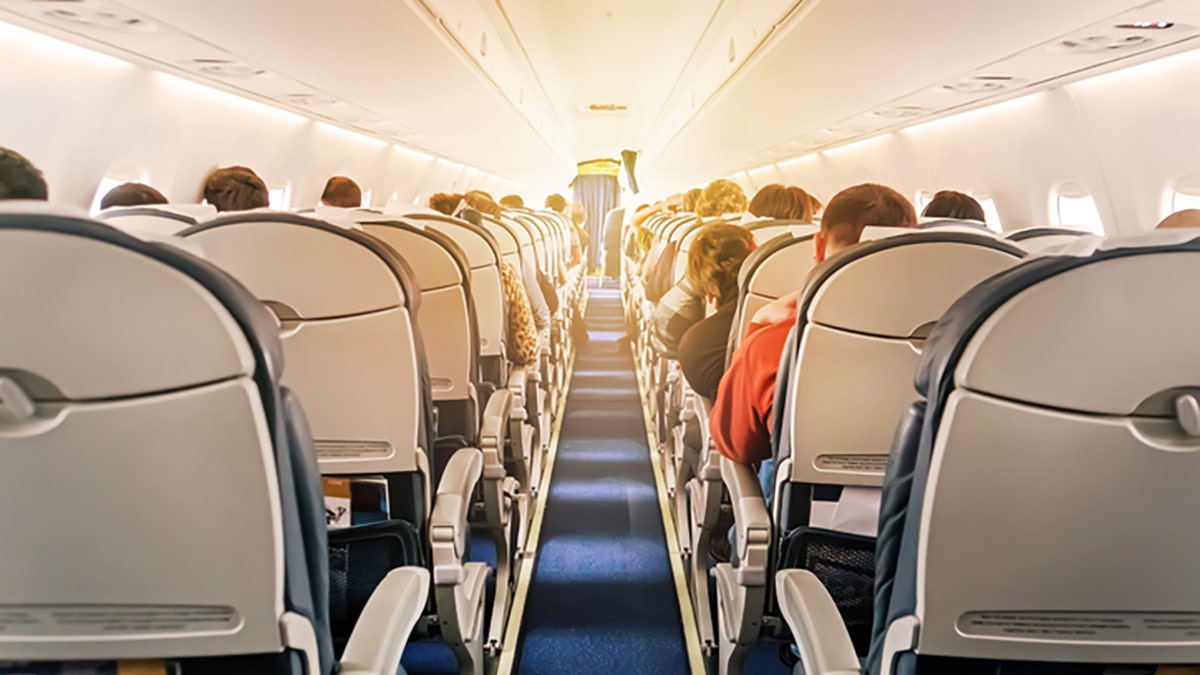
The research team said it hopes that incorporating new information from its findings — for example, by offering additional safety briefings to older passengers — could help further accelerate the de-boarding process. (iStock)
The authors added that in addition to mobility and cognitive limitations, “other challenges include impaired vision or hearing, limited manual dexterity, difficulties in interpreting signage or auditory alarms, and a higher susceptibility to panic or physical injury during high-stress situations.”
The research team said it hopes that incorporating that information from its findings — for example, by offering additional safety briefings to elderly passengers — could help further accelerate the de-boarding process.
CLICK HERE FOR MORE LIFESTYLE STORIES
Children, babies and pregnant women also introduce unique physical capabilities and behaviors that add another vital layer to evacuation modeling — which the group said it plans to investigate in future work.
“Airlines must always comply with FAA and foreign government safety rules.”
Zhang added, “We hope these findings help airlines proactively mitigate risks. By understanding how passenger distribution affects evacuation, airlines could potentially implement more strategic seating arrangements to optimize safety without compromising operational efficiency.”
The U.S. Department of Transportation says on its website, “Airlines must always comply with FAA and foreign government safety rules. There are FAA and foreign government safety rules that may restrict certain passengers with disabilities from sitting in an exit row seat.”
“By understanding how passenger distribution affects evacuation, airlines could potentially implement more strategic seating arrangements to optimize safety without compromising operational efficiency,” said the study co-author. (iStock)
The site also notes, “Be aware that while an airline is not required to allow you to select a specific seat, it is required to provide you a seat that meets your needs (with certain limitations for bulkhead seats and emergency-exit seats).”
CLICK HERE TO GET THE FOX NEWS APP
It also notes that those who have “a disability and would prefer or need a certain type of seating accommodation … should contact the airline at the time you make your reservation to learn more about the method that the airline uses to make arrangements for a seating accommodation.”