


 PA Media
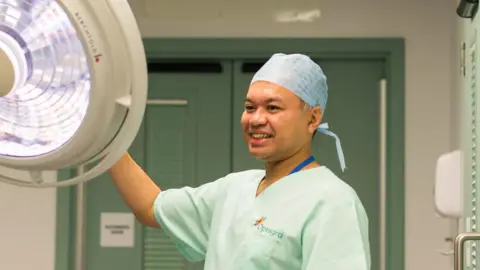
A London-based eye-surgeon has described how he himself underwent emergency surgery for a detached retina after a blind spot appeared in his right eye.
Dr Amir Hamid, 51, has performed more than 10,000 cataract and laser refractive surgeries in his career, but found himself in the patient’s chair last year with the condition, which could have left him with permanent vision loss.
Due to his knowledge and quick action, he was treated the same day and recovered within weeks.
Hamid is now urging people to look out for the signs of various eye conditions so they can be treated before they become irreversible.
“At the end of July, I noticed that there was a blank patch in the field of vision in my right eye and immediately realised that it could be the start of a detached retina,” Hamid said.
“I very quickly went down to the hospital to get my eyes tested and scanned…within three hours I was scheduled for surgery on my right eye,” he recalled.
“As an eye surgeon, it could have been a very stressful and frightening time, but I know some very good surgeons and I trusted the process.
Hamid, who is chief medical officer for eye hospital group Optegra, said he was “very lucky”, as his condition was slow moving.
“I had the treatment done in time to preserve all my sight and after a couple of weeks’ recovery I could go back to work.”
What is a detached retina?
Retinal detachment occurs when the thin layer at the back of the eye – the retina – becomes loose.
Symptoms include:
- Floaters (dots and lines) or flashes of light in your eye
- A dark “curtain” or shadow in your vision
- Changes to your eyesight, such as blurred vision
Anyone experiencing these symptoms is advised to contact NHS 111.
A detached retina is usually caused by changes to the jelly inside the eye, which can happen as we age.
It is more likely to happen in people who are short-sighted or those who have had eye surgery, according to the NHS.
The condition needs to be treated quickly to prevent permanent damage to eyesight, the NHS says.
 PA Media
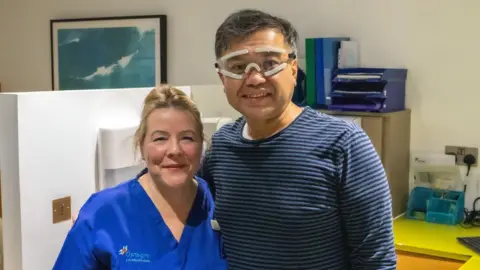
As a side effect of his surgery, Hamid said he later developed a cataract in his right eye and chose to have it treated privately before it affected his vision.
However, NHS surgery was available in England to those with more advanced cataracts.
After his own experience, the father-of-two is urging people to be aware of any unusual eye symptoms and seek treatment quickly.
“You certainly shouldn’t ignore the symptoms of retinal detachment, because it can lead to loss of vision, and if it’s left too late, it may be difficult to recover that vision,” he said.
“With a cataract, you’ll start to notice your vision getting blurred for different distances and it’s important to get a diagnosis, because cataracts are completely reversible.
“Cataract surgery is one of the best procedures that has ever been created because it can actually make your vision better than it was before.”
Although the condition can be detected in routine eye tests, Hamid said he had seen a increase in patients with advanced cataracts since the pandemic.
“Remember that it’s always better to have a diagnosis, because then we know what it is and how we can fix it.
“The older population in particular are often more accepting of certain changes or compromises in their lifestyle and health, but that shouldn’t be the case because things can be done.”